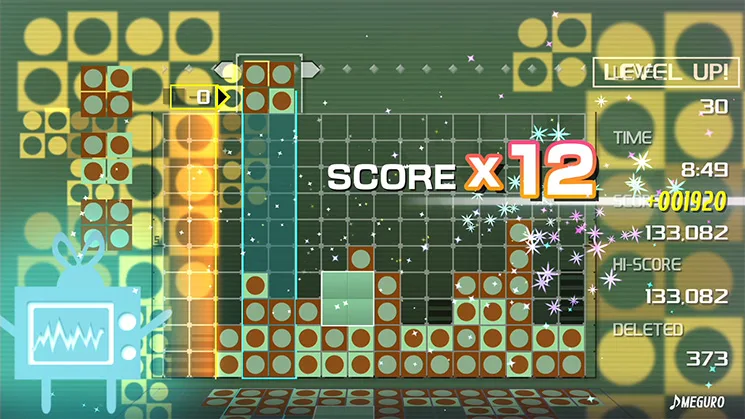
Welcome to Lumines Remastered, the vibrant puzzle game where you clear blocks by matching them into 2x2 squares. As the timeline sweeps across the screen, you’ll need to think fast and strategically to keep the screen clear and the beat alive. It’s a fantastic blend of music, rhythm, and puzzle-solving that’s perfect for quick sessions or deep dives.
This guide is here to help you master every aspect of Lumines Remastered. We’ll cover everything from the basics of clearing blocks and understanding special pieces to conquering the various challenge modes. Whether you're aiming for high scores on the leaderboards, unlocking all the Steam Achievements, or just want to understand the deeper strategies, we've got you covered.
1. Block basics
Learn the fundamentals of Lumines Remastered's block system! Understand the 6 basic block types and how their rotations create 16 unique block combinations.
Hey there! Welcome to Lumines Remastered. Let's dive into the absolute core of the game: the blocks themselves. It might seem simple at first, but understanding how these little guys work is key to mastering the game.
At its heart, Lumines Remastered is all about six basic block shapes. You've got your 'blankey', 'oney', 'twoey', 'deuce', 'trey', and 'quad'. But here's the cool part: when you rotate these blocks, they can actually form different unique shapes. So, while there are only five original block types, their rotations mean you're dealing with more unique block configurations than you might think!
- Blankey: This one's straightforward. It doesn't change its shape when you rotate it. So, it's just 1 unique block.
- Oney: This block shape can be rotated four different ways, giving you 4 unique block variations.
- Twoey: Similar to the oney, the twoey also has four distinct orientations when rotated, resulting in 4 unique blocks.
- Deuce: The deuce is a bit simpler in its rotations, offering 2 unique block shapes.
- Trey: This block shape can be rotated into four different configurations, giving you 4 unique blocks.
- Quad: Like the blankey, the quad doesn't change its appearance no matter how you spin it. It's just 1 unique block.
So, when you add up all the possible rotations, those five original blocks actually give you a total of 16 unique block combinations. It's a neat little system that makes the puzzle aspect of Lumines so engaging!
It turns out there's a bit of math behind this! If you think about a block made of four squares, and you consider all the possible ways those squares can be arranged, you get 16 combinations. It's like 4 squared (4x4), which equals 16. Pretty neat, huh?
Someone pointed out a more precise mathematical reason: each square within a block can be one of two colors, and since there are four squares per block, it's actually 2 to the power of 4 (2^4), which also equals 16. Thanks for that insight!
2. Game mechanics
Learn the core mechanics of Lumines Remastered, from dropping blocks to clearing lines and scoring big with combos and destroyers. Master the grid!
Alright, let's break down how Lumines Remastered actually works. It's super easy to pick up the basics, but getting really good? That's where the fun is! Think of me as your co-pilot here, showing you the ropes.
Here’s the lowdown on the rules:
- Dropping Blocks: You'll see blocks made of four squares (a 2x2 shape) appear one at a time. Your job is to drop them into the grid.
- Block Physics: When you drop a block, it falls straight down until it hits something – either another block already in the grid or the bottom of the playfield.
- Partial Landings: Sometimes, only part of a block will land on something. Don't worry, the rest of the block keeps falling until it finds a solid surface.
- Clearing Blocks: This is the core of the game! When you create a solid block or rectangle (either all the same color or white/clear blocks), it'll disappear. But there's a catch: it only vanishes when the 'timeline' – a bar that sweeps across the grid from right to left – passes over it. This timeline is kind of like the playhead in music software, hence the name 'Lumines'.
- Combos and Scoring: Want to rack up some serious points? If you can add more squares to a cleared rectangle *before* the timeline hits it, creating even bigger rectangles, you'll get a massive score bonus! The more squares you clear at once, the higher the multiplier.
- Destroyer Blocks: Keep an eye out for special blocks that have a contrasting dot inside. These are 'destroyers'! When you clear a rectangle that includes a destroyer block, all adjacent squares of the same color (horizontally or vertically, not diagonally) will also disappear. This is awesome for clearing out big chunks of the grid and getting huge points.
- Game Over: The classic game over condition – if you fill up the entire screen so that you can't drop any more blocks, it's game over. So, always keep that grid clear!
- Focus on creating those solid 2x2 squares or larger rectangles. They're your bread and butter for clearing the board.
- Don't be afraid to use the 'destroyer' blocks strategically. They can save you when the screen starts getting crowded.
- Always be thinking one step ahead. Try to anticipate where your next block will go and how it might set up future clears.
4. Combos and time line strategies
Learn how to maximize your score in Lumines Remastered by mastering combos and strategically using the timeline. Get tips on block placement and timing!
Alright, let's talk about how to really rack up points in Lumines Remastered by understanding combos and how the timeline works. It's all about smart block placement and timing!
When you manage to create a block of at least four squares that are all the same color, they'll start to glow. This glowing block is your key to scoring big. The timeline, which sweeps across the screen, will eventually hit this glowing block, and when it does, the block disappears, and everything above it drops down. This is where the magic happens.
While a block is glowing, if you can get any other two squares of the same color to touch it, you'll boost your score. Basically, any two or more squares that connect to that glowing block will create more squares, leading to even bigger scores. The trick here is to give yourself as much time as possible to build these combos.
To get the maximum time for setting up these combos, you'll want to wait until the timeline has just passed the area where your glowing block is before you make it disappear. Sometimes, this means you'll need to speed things up by dropping blocks using the down arrow. Other times, you'll be patiently waiting for the timeline to clear the area before you drop your block. Both approaches can work, so pay attention to the rhythm of the game.
Combos are seriously your best friend for increasing your score, so don't be shy about throwing blocks with matching colors at those glowing deletes. Go for it! However, there's a catch: if you're just mindlessly dropping blocks, you might end up creating a huge mess that's difficult to clear later. This is part of the fun and challenge of Lumines – you have to constantly think ahead, and taking risks can lead to big rewards or a big pile of blocks!
One final, high-stakes rule about the timeline: never create a delete when the timeline is smack in the middle of it. If you do this, only the part of the block to the right of the timeline will be destroyed. The part to the left will just hang around. Usually, this is a bad thing and can mess up your plans. However, if you're feeling daring, this can sometimes be used as an advanced technique to help you out, especially in the 2x puzzles (we'll cover those later!). Just remember, timing is everything with the timeline!
5. Destroyer square strategies
Learn the best strategies for using Destroyer Squares in Lumines Remastered. Plan ahead and maximize your clears for higher scores!
Alright, let's talk about those tricky Destroyer Squares in Lumines Remastered. You know, the ones with the little contrasting colored blocks inside them? They're super useful, but you gotta use 'em right to get the most bang for your buck.
Basically, when a Destroyer Square clears, it takes out any like-colored squares touching it horizontally or vertically, and then any squares touching *those* squares, and so on. It's a chain reaction!
These guys don't show up too often – maybe every 36 blocks or so, give or take. So, when you get one, you really want to make it count.
The key is to keep an eye on the upcoming blocks – those three on the left side of the screen. The one at the very top of that queue is the next block you'll be dropping. If you can spot a Destroyer Square coming up three blocks in advance, you'll have plenty of time to plan your move.
Key Strategies for Destroyer Squares:
- A. Don't just clear one block: Just using a Destroyer Square to make a single delete without clearing anything else is a wasted opportunity. You get no real benefit from it.
- B. Position for maximum effect: You can drop a Destroyer Square into a good spot to clear a decent chunk of blocks. This is better than just clearing one, but it's still not the absolute best way to use them.
- C. The
Similar guides you might like





100% Human-Written. Community Verified. Learn how Ludo.guide verifies content