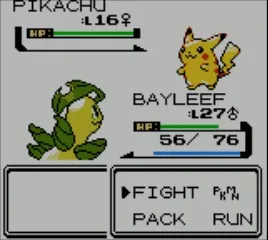
Welcome to Pokémon Crystal, the definitive version of the second generation of Pokémon adventures! As a trainer in the vibrant world of Johto, you’ll explore diverse towns and routes, from New Bark Town to the challenging Battle Tower. Your journey involves training a team of Pokémon, battling rival trainers and Gym Leaders, and uncovering the mysteries surrounding the legendary Pokémon Suicune. This RPG experience builds upon its predecessors with new features like Pokémon breeding and animated sprites, offering a richer journey for both newcomers and seasoned players.
This guide is your essential companion for mastering every aspect of Pokémon Crystal. We’ll provide expert tips and detailed walkthroughs to help you navigate every route, conquer tough boss battles, and ultimately, catch 'em all. Whether you're aiming to perfect your breeding strategies, overcome the toughest opponents in the Battle Tower, or simply want to experience the full story from start to finish, this guide has you covered.
Zephyr Badge - Game Start-Up and New Bark Town
Learn how to start your Pokémon Crystal journey, choose your starter, and navigate New Bark Town. Get your PokéGear and first Potion!
As you start up the game, you will be able to load a previous file (if applicable), start a new game, or use the configuration options. After messing with the latter if you so choose, when you start a new game the first thing you'll be confronted with is being asked the time of day. It's probably a good idea to answer with respect to your current time in the real world: it'll make it easier to keep track of in-game events and such that rely on the clock without being forced to check your clock every time. Thereafter, you'll be introduced to the world of Pokémon by Professor Oak, and soon gain control of your character in the Johto region's New Bark Town.
When you gain control of your character, you'll be on the second floor of your house in New Bark Town. Go down the stairs and you'll speak with your mom. She'll tell you that Professor Elm, who is in his lab next door, wants to see you, then she'll give you your PokéGear, an item with the main function of being able to call NPCs in the game, though more functions can be unlocked throughout the course of the game such as a radio and a map. You'll have to confirm your day of the week and your Daylight Savings Time setting now as well before you leave.
Once you've left the house, go into the building to the west, Professor Elm's lab. Inside, go north and speak to Elm; he'll tell you that you need to meet his acquaintance, Mr. Pokémon, and that you'll be given a Pokémon on the journey. The three Pokémon you can choose from are on the table. You can only pick one, and you'll pick from these Pokémon:
- Cyndaquil (on the left): Cyndaquil is a Fire-type Pokémon and will thus afford you a decent advantage in the early game since the second Gym is a Bug-type Gym, and later on there's also a Steel-type Gym he'll fare well at. Cyndaquil and his evolutions are relatively fast Special-attacking Pokémon, and they have a decent moveset to back it up with Fire, though comparatively paltry for other moves of other types so Typhlosion will likely be running a more mixed set of moves than not. Overall though Cyndaquil is probably the easiest of the three Pokémon to contend with as a starter.
- Totodile (in the middle): Totodile is a Water-type Pokémon. He doesn't afford you any significant advantage in terms of Gym progression (the Fire, Rock, and Ground Gyms are all in Kanto, way late in the game), though Water is one of the few types that can hit neutrally against Steel (which resists practically everything). Totodile's family of Pokémon are predominately Physical-attacking. Though not quite as strong as Typhlosion - although the difference is marginal - nor quite as fast, Totodile does pack superior bulk. Totodile's family is only weak to two types of attacks as well, instead of Cyndaquil's three or Chikorita's five, which makes Totodile a decent option as well for a slightly more difficult game or for those that prefer a slightly more defensive game.
- Chikorita (on the right): Chikorita is a Grass-type Pokémon. He is probably the hardest Pokémon for a player to use: the first two Gyms use Pokémon that can easily deal supereffective damage to Chikorita with it being unable to deal reliable damage back. Throw in the Steel-type Gym plus three other types (altogether: Fire, Ice, Flying, Bug, Poison) that can deal super-effective damage to it - all of which have a Gym in this game at some point, 3 in Johto and 2 in Kanto - and Chikorita isn't going to have a fun time at the Gyms. Further, Chikorita is a more defensive, bulky Pokémon: its stats, while suited for a mixed-attacker build, aren't very reliable for dealing direct damage, and Meganium is better off for bulk. Players opting for Chikorita will probably experience the hardest gameplay.
Here's a quick evaluation of their base stats and types as they evolve as well: they do so at Levels 14, 18, and 16, respectively, and 36, 30, and 32, respectively. This means that Totodile is the quickest to reach his final stage and Cyndaquil the lowest. If you don't know what a base stat is, suffice it to say that it simply means the higher the Pokémon is in that stat the stronger it'll get.
| # | Pokémon | Type | Base Stats | Total | |||||
|---|---|---|---|---|---|---|---|---|---|
| HP | ATK | DEF | SPA | SPD | SPE | ||||
| #152 | Chikorita | Grass | 45 | 49 | 65 | 49 | 65 | 45 | 318 |
| #153 | Bayleef | Grass | 60 | 62 | 80 | 63 | 80 | 60 | 405 |
| #154 | Meganium | Grass | 80 | 82 | 100 | 83 | 100 | 80 | 525 |
| #155 | Cyndaquil | Fire | 39 | 52 | 43 | 60 | 50 | 65 | 309 |
| #156 | Quilava | Fire | 58 | 64 | 58 | 80 | 65 | 80 | 405 |
| #157 | Typhlosion | Fire | 78 | 84 | 78 | 109 | 85 | 100 | 534 |
| #158 | Totodile | Water | 50 | 65 | 64 | 44 | 48 | 43 | 314 |
| #159 | Croconaw | Water | 65 | 80 | 80 | 59 | 63 | 58 | 405 |
| #160 | Feraligatr | Water | 85 | 105 | 100 | 79 | 83 | 78 | 530 |
Once you've chosen your Pokémon, Professor Elm will tell you that you should be able to find Mr. Pokémon north of Cherrygrove City, and that you can use the machine in the northwest corner of his lab to heal your Pokémon if you want. As you leave the lab you'll also receive a Potion.
Basics of the Game
Master Pokémon Crystal controls and field mechanics, from finding items to trainer battles and town resources.
- 1Use the D-Pad to move your character in the field and navigate menus.
- 2Press the A Button to confirm choices, examine objects in front of you, and advance text.
- 3Press the B Button to cancel some decisions.
- 4Press the Start Button to bring up the main menu.
- Items can be found in the field as Pokéball icons; examine them by facing them and pressing A. Be aware that some Pokéball icons may actually be Voltorb or Electrode.
- Hidden items are invisible and require you to face the tile they are on and press A to find them. Look for contextual clues like empty grass patches or standalone trees, and later use the Itemfinder to detect them.
- Some NPCs will give you items directly when you speak to them, sometimes requiring a specific task or time of day.
- Berries and Apricorns can be found in trees.
- Wild Pokémon can be encountered by walking in tall grass, in caverns, or by using moves like Headbutt, Surf, or Fishing Rods.
- Trainer Battles occur when you enter a trainer's line of sight. You will battle 1 to 6 Pokémon and gain money and experience.
- Hidden Machines (HMs) teach moves that overcome field obstacles like rocks, trees, or darkness, and are necessary for progression. You typically receive an HM after defeating the appropriate Gym Leader.
- In towns, visit Pokémon Centers to heal your Pokémon's HP, PP, and status conditions for free. Use the PC to store Pokémon (you can only carry six at a time), store items, and get your Pokédex evaluated. The second floor of Pokémon Centers allows trading and battling with other players via a Game Link cable (Game Boy Color) or infrared ports (Nintendo 3DS VC). The Time Capsule allows trading with Pokémon Red, Blue, Green, and Yellow Versions.
- Visit Poké Marts to buy items like Pokéballs, medicine, and other useful resources.
Zephyr Badge - Meeting Mr. Pokemon
Collect a Potion, Berry, Map Card, PSNCureBerry, Mystery Egg, and Pokédex on Route 29, Cherrygrove City, and Route 30 in Pokémon Crystal.
- Starter Pokémon at Level 5+ (Cyndaquil, Totodile, or Chikorita)
- 1From the start of Route 29, go southwest through the grass to a white path.
- 2Follow the path north through a gap in a ledge, then east to patches of grass.
- 3Go north through the grass, then northeast to a dead end to find a Potion.
- 4Return west through the grass and head west to another patch of grass.
- 5Go westward through this grass, find a standalone tree to the north, and collect a Berry. Berries heal 10 HP instantly or once during battle if held when HP is low.
- 6Go south into the grass, then west into Cherrygrove City.
- 7In Cherrygrove City, speak to the old man who will give you a tutorial and the Map Card, which enables the map on your PokéGear.
- 8Heal your Pokémon at the Pokémon Center and buy items from the Poké Mart if desired.
- 9Head north from Cherrygrove City onto Route 30.
- 10Go through the grassy patch, then north to a house. Collect a Berry from the tree outside and speak to the man inside for a second Berry.
- 11Return outside and go north through the grass to a white path.
- 12Head east through the grassy path north, then through the grass and trees to another house. Collect a PSNCureBerry from the tree west of the house.
- 13Enter the house and speak with Mr. Pokémon. You will receive a Mystery Egg to give to Professor Elm. Professor Oak will give you a Pokédex.
- 14After Professor Oak leaves, you will rest and heal your Pokémon.
- 15Exit the house and receive a call from Professor Elm. Backtrack to Cherrygrove City.
- 16Heal your Pokémon at the Pokémon Center.
- 17Attempt to leave Cherrygrove City by heading east and you will battle a random passerby boy.
- 18Warning: The opponent will use one of Totodile (Lv. 5), Chikorita (Lv. 5), or Cyndaquil (Lv. 5). The battle earnings are $300.
- 19After the battle, heal your Pokémon if needed.
- 20Return east to Route 29, then east to New Bark Town.
- 21Enter Professor Elm's lab. A police officer will ask for the name of the boy you fought. Enter any name (e.g., Silver).
- 22Talk to Professor Elm to keep the Mystery Egg. You are advised to head to the Pokémon Gym in Violet City.
- Consider holding onto the first Berry you find on Route 29, as you may not have other healing items yet.
- Buying a single Potion from the Poké Mart before the battle in Cherrygrove City is recommended if you lack one.
- The opponent in Cherrygrove City may have a type advantage, but their damaging moves are Normal-type, and they can only lower your Attack or Defense.
- Potion
- Berry (x3)
- Map Card
- PSNCureBerry
- Mystery Egg
- Pokédex
- $300 (from trainer battle)
Basics of the Game (2)
Learn about controls, finding items, wild encounters, trainer battles, HMs, and town resources in Pokémon Crystal. Your essential guide to the game's overworld.
This guide covers the basics of navigating and interacting with the world in Pokémon Crystal, including controls, finding items, encountering Pokémon, trainer battles, using HMs, and deploying town resources.
Controls
| Button | Function |
|---|---|
| D-Pad | Move around in the field and move cursors in menus. |
| A Button | Confirm choices, examine the tile in your facing, and advance text. |
| B Button | Cancel some decisions. |
| Start Button | Bring up the menu. |
| Select Button | N/A |
The Field
The field is the overworld, including dungeons, towns, and routes. It's where you'll find items, encounter Pokémon, and interact with trainers.
Items in the Field
Items can be found in various ways:
- In the Open: Appear as Poké Balls. Examining them yields the item, but beware, some may be Pokémon like Voltorb or Electrode.
- Hidden: Invisible items that require facing the tile and pressing A to find. Look for contextual clues like empty grass patches, boulders, or trees. The Itemfinder can help locate them later.
- From People: NPCs may give you items directly or after completing a task or visiting at a specific time.
- Trees: Berries and Apricorns can be found in trees.
Tall Grass
Found in many Routes, walking in tall grass can trigger random wild Pokémon encounters. The type and frequency of Pokémon depend on the area. Wild Pokémon can be caught and added to your party. Items like the Cleanse Tag or Repels can reduce encounters.
Other Wild Encounters
Wild Pokémon can also be found in caverns by walking around. Later, you'll unlock methods like Headbutt, Surf, and Fishing Rods, which yield different Pokémon than grass encounters.
Trainer Battles
Trainers in the overworld will initiate battles when you enter their line of sight. These battles typically involve 1 to 6 Pokémon and yield more money and 50% more EXP than wild Pokémon battles. They can often be avoided by careful movement.
Pokémon Moves in the Field (HMs)
Hidden Machines (HMs) teach moves that can overcome field obstacles like rocks, trees, or dark caves. Unlike TMs, HM moves can be used an unlimited number of times and are essential for progressing through the game. Using an HM often requires a specific Gym Badge.
Town Resources
Most towns offer essential resources:
- Pokémon Centers: Marked by a "Poké" sign. Heal your Pokémon's HP, PP, and status conditions for free. The PC allows depositing/withdrawing Pokémon, storing items, and evaluating your Pokédex. The second floor offers multiplayer battling and trading, and the Time Capsule for trading with older Pokémon games.
- Poké Marts: Marked by a "Mart" sign. Purchase items like Poké Balls, medicine, and various other useful resources for your journey.
Similar guides you might like






100% Human-Written. Community Verified. Learn how Ludo.guide verifies content