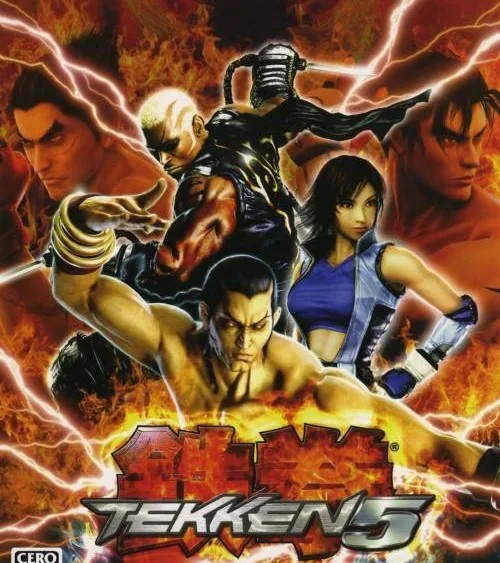
Welcome to Tekken 5, the PlayStation 2 fighting game where you master the iron fist. Developed by NAMCO and released in 2004, Tekken 5 offers a dark and balanced combat experience. You'll progress through a story mode, learning character archetypes and fighting styles as you go.
This guide is your key to conquering Tekken 5. We'll cover everything from fight money strategies to defeating every boss, including the formidable Jinpachi Mishima. Whether you're aiming to complete the story or master the game's mechanics, this guide provides the insights you need to succeed on the PlayStation 2.
Ia. WHY?
Dive into Tekken 5's mechanics and move names. This guide explains the reasoning behind the Japanese move names and their impact on understanding the game's deep combat system.
Hey there! So, you're diving into Tekken 5, huh? Awesome! It's a fantastic game, and I'm stoked to help you get a handle on it. You might be wondering why this guide is structured the way it is, or why we're focusing on certain aspects. Well, that's exactly what this section is all about – understanding the 'why' behind the madness of Tekken 5!
One of the biggest things I noticed when I first started playing Tekken 5 seriously was how different the American move names were compared to the Japanese ones. It can get super confusing when you're trying to talk strategy with other players or look up specific techniques. Some of those American names are just wild, right? Like, 'Three Ring Circus' or 'Laser Scraper' – they don't exactly scream 'deadly martial arts,' do they? The Japanese names often give you a much better sense of what the move actually does or its origin.
The Japanese players actually have a bit of an edge here. With a Tekken ID card, they can access Tekken-Net through their phones to check out official moves lists. It's a bummer we can't access it directly online, but it's a cool feature nonetheless. These official lists usually include frame data and all sorts of technical details that are super helpful for serious players.
Now, I know some of you might just want the raw moves lists, and that's totally fine! You'll find plenty of those around. But if you're like me and have a bit of an interest in Japanese culture or language, this guide will try to shed some light on that. My goal is to help you not only nail the combos but also understand the nuances of the character names and move pronunciations. As a professional translator, I figured I could offer a unique perspective on this.
If all that sounds like too much and you just want the pure gameplay breakdown, no worries. You might be better off checking out other guides that focus solely on the mechanics. But remember, this game was made by Japanese developers, so understanding the Japanese names can really give you a deeper appreciation for the 'real' moves and their intended meaning. It’s all about getting the full Tekken 5 experience!
Id-1. LEGEND
Learn to read Tekken 5 move lists and understand the game's notation system, including button inputs, directional commands, and move properties.
Alright, so you're diving into Tekken 5 and seeing all these crazy button combinations in move lists? Don't sweat it! This section is basically your cheat sheet to understanding exactly what your character can do and how to pull it off. Think of it like learning a secret language that unlocks all the cool moves.
We're going to break down all the symbols and abbreviations you'll see. Once you get this, reading any move list will be a piece of cake, and you'll be executing combos and special moves like a pro in no time. Let's get this legend decoded!
Notation Breakdown:
- Basic Buttons: 1 = Left Punch, 2 = Right Punch, 3 = Left Kick, 4 = Right Kick. Simple enough, right?
- Directions: These are pretty standard fighting game terms. Think of them like a mini-joystick input:
- N = Neutral (letting go of the stick)
- u = Up
- d = Down
- f = Forward (towards the opponent)
- b = Back (away from the opponent)
- Combinations like ub (up-back), uf (up-forward), db (down-back), df (down-forward) just mean you're hitting those diagonal directions.
- Holding Directions: When you see a capital letter like U, B, F, etc., it means you need to hold that direction. So, F means hold forward, DB means hold down-back.
- Combining Inputs:
- '+': Means press buttons at the same time. So, 1+2 means hit Left Punch and Right Punch together.
- ',': Means press buttons one after another, in sequence.
- '()': Means hold the button down.
- ':': This is the tricky one – it's a 'Just Frame' input. You have to press the second button at the *exact* moment the first button connects. We're talking milliseconds here, so it takes practice!
- '*', '#', '@', '?': These are just notes about new moves, changed commands, or uncertain official names. Don't worry too much about these for now.
- Move Properties: This tells you how the move behaves and how to defend against it.
- h = Hits High (can be ducked or blocked standing)
- m = Hits Mid (must be blocked standing)
- s = Special Mid (can be blocked standing or crouching – a bit of a mix-up!)
- l = Hits Low (must be blocked low)
- ! = Cannot be blocked (rare, but powerful!)
- Situational Commands: These apply only under specific conditions.
- ch = Counter Hit (the move lands while your opponent is attacking)
- fc = Fully Crouched (you're in a crouch state)
- wr = While Rising (as you're getting up from a crouch)
- ss = Side Step (moving sideways to dodge)
- bt = Back Turned (your back is to the opponent)
- Special Motions: These are common fighting game inputs.
- qct = Quarter Circle Towards (Down, Down-Forward, Forward)
- qcb = Quarter Circle Back (Down, Down-Back, Back)
- hct = Half Circle Towards (Back, Down-Back, Down, Down-Forward, Forward)
- hcb = Half Circle Back (Forward, Down-Forward, Down, Down-Back, Back)
- 360 = Spin the joystick a full circle.
- Other Notations:
- 'back', 'right side', 'left side': Refers to your position relative to the opponent.
- '_': Means you can do either the first option or the second.
- '^': Used for combo throws, indicating actions to be performed during a specific part of a sequence.
- Don't try to memorize everything at once! Focus on the basic buttons (1-4) and directions (u, d, f, b) first.
- When you're looking at a specific character's move list, pay attention to the property symbols (h, m, l, s) – they're game-changing for knowing how to defend.
- Practice the special motions (qcf, qcb, etc.) in training mode. They become second nature with repetition.
- The 'Just Frame' (:) notation is for advanced players. Don't get discouraged if you can't nail it immediately; focus on the core inputs first.
- Keep this legend handy while you're playing. It's your best friend when you're trying to figure out a new move or combo.
Id-2. HOW TO FIND IT
Learn how to use the Find feature in Tekken 5 FAQs to quickly locate specific sections and character names by matching case.
To locate a specific section within the Tekken 5 FAQ, lean on the 'Find' feature. This function is typically located within the 'Edit' menu of your application.
To use the 'Find' feature, type the text you wish to locate into the search bar. For instance, if you are trying to find information on a particular character, search for their name written in all capital letters. Ensure that the 'match case' option is selected for precise results. This method also works for finding any subsection, as they are also written in all capital letters.
- Section headings and subsection titles are written in all caps for easy searching.
- Use the 'match case' option in the 'Find' feature for more accurate searches.
- The 'Find' feature is typically accessed through the 'Edit' menu.
Id-3. TEKKEN 101
Learn Tekken 5 basics: 3D movement, strings, mix-ups, and 'while rising' states. Essential for new players.
- 1Understand Tekken 5 is a 3D fighter, unlike 2D games such as Guilty Gear, Street Fighter, or King of Fighters.
- 2Focus on executing strings (combos) and mixing in mid-hitting attacks (overheads) rather than zoning or special moves.
- 3Practice sidestepping to evade attacks and reposition yourself.
- 4Learn that Tekken 5's reversals are generally easier to perform than in Virtua Fighter.
- 5Grasp the concept of 'states' in Tekken 5; nearly all moves performed while getting up from a crouch are considered 'while rising' moves.
- 6Lean on crouch-dashes only with characters who possess them, as they enable specific moves.
- 7Recognize that while moves may seem more committed, the system is designed to be addictive and fun.
- 8Be aware that players develop routines involving strings, sidesteps, and crouching to trap opponents in mix-ups, which can be complex and lengthy.
- 9Consider Tekken 5's gameplay akin to a boxing game due to its emphasis on layered offense and defense.
- For in-depth resources, the site Tekken Zaibatsu, run by Castel, is highly recommended.
- If you are familiar with other fighting games, focus on adapting to the 3D movement and string-based offense.
- Experiment with different 'while rising' options after getting up from a crouch to surprise opponents.
- Don't be discouraged by the complexity of opponent routines; practice and observation will help you identify and counter them.
Similar guides you might like





100% Human-Written. Community Verified. Learn how Ludo.guide verifies content